Building Coding Agents: Architecture and Guardrails
How coding agents work: repo tools, planning, tests as rewards, sandboxes, and evaluation for software engineering agents.
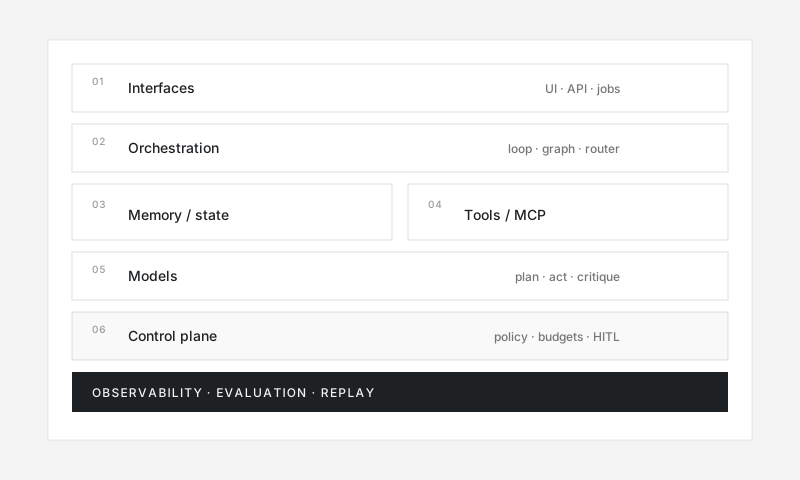
A coding agent is an agentic system that modifies software by reading a codebase, editing files, running checks, and iterating toward a green state.
Core tool surface
- Read/list files
- Search (ripgrep-style)
- Apply patches
- Run tests/linters/typecheckers
- Optional: browser, package install (high risk), PR creation
Architecture that works
- Spec intake — issue/PR description → acceptance checks
- Map — locate relevant files
- Edit loop — patch → test → diagnose
- Reflect — if tests fail, form a new hypothesis
- Hand off — PR summary + residual risks
Patterns: tool use, reflection, plan-and-execute.
Sandbox requirements
Coding agents without isolation are security incidents waiting to happen.
- Ephemeral workspaces
- Network allowlists
- No host secrets by default
- Resource limits (CPU, disk, time)
- Read-only mounts for sensitive references
Evaluation
Grade on:
- Unit/integration tests passing
- Diff size / blast radius
- Style and typecheck
- Whether unrelated files changed
- Time and cost to green
Use real repository tasks, not only synthetic snippets.
Failure modes
- Endless refactors unrelated to the task
- Deleting tests to “make them pass”
- Hallucinated APIs
- Dependency thrash
- Secrets committed to diffs
Mitigate with protected test commands, diff allowlists, and secret scanning.
Summary
Coding agents are tool loops with tests as verifiers. Invest in sandboxing and eval tasks; the model is only one part of the system.
FAQ
Frequently asked questions
What makes a coding agent different from chat code generation?
A coding agent iteratively edits a repository, runs tools like tests and linters, and continues until checks pass or it escalates—rather than emitting a single code block.